The First National Dialogue on Writing Centres
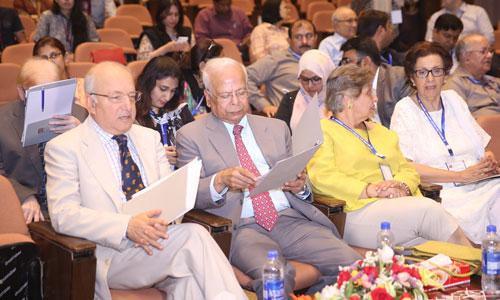
The First National Dialogue on Writing Centres, organized by the Ardeshir Cowasjee Centre for Writing (ACCW) was held at the G&T Auditorium, IBA Karachi. The objective of the symposium was to introduce the concept of a Writing Centre as an academic support at tertiary and higher education levels. The plenary discussions and presentations deliberated on the need for Writing Centres in institutes with an L2 (2nd Language) as a mode of instruction and assessment.
The session commenced with recitation of verses from the Holy Quran, followed by opening remarks by Senator (R.) Javed Jabbar. Thanking the members in the audience, he said, 'I see before me a distinguished range of scholars, faculty and students. Thank you so much for taking the time to come to IBA.' He thanked Dr. Farrukh Iqbal, Dr. Ishrat Husain, the Cowasjee Foundation and its Trustee, Ms. Ava Cowasjee, who enabled the creation of this Centre, Dr. Faiza Mushtaq and Ms. Maria Hassan, for overseeing the ACCW. 'This symposium honors Mr. Cowasjee, who wrote with great courage and commitment, week after week; may he rest in peace', said Mr. Jabbar.
Speaking about writing, Mr. Jabbar stated that it is a great process, which distinguishes human beings from animals and birds. Neither of these species can codify their thoughts and emotions, algorithms, theorems and then decode them, and therefore, this is humanity's greatest invention. He concluded by stating that the pivotal role of writing cannot be ignored.
Ms. Maria Hassan, Director ACCW and Professor Social Sciences & Liberal Arts, IBA, thanked all the participants for attending and began by speaking about the fundamental concept of Writing Centres. 'Writing is an ongoing process and the ACCW assists students in developing their thoughts, whilst also improving their writing skills,' she stated. In Pakistan, students have to deal with multiple languages at the same time, which makes higher education more challenging for them. Therefore, Writing Centres can play a significant role in improving the pedagogical framework for writing courses at universities.
Followed by this, Dr. Ishrat Husain, Prof. Emeritus & Chairman, Centre for Excellence in Islamic Finance IBA, addressed the audience. 'Most of the research and scientific discoveries in the world are taking place in the English language. If we want to be a part of this global change, then we need to be competent in this language.' The Writing Centre offers students a chance to master their writing skills, especially those from the Talent Hunt Programs. He also thanked Ava Cowasjee, the Cowasjee Foundation and Mr. Jabbar for overlooking the Centre.
The next address was delivered by Ms. Ava Cowasjee, daughter of Mr. Ardeshir Cowasjee, who is the inspiration of the ACCW. 'My father believed that the sole way a country could progress was through mass education, especially for women.' She also shared some words of wisdom said by her father, 'Go out in the world of today, and try to change things through writing, and maybe you can change the attitudes of those who fraudulently occupy positions of power in our country. Remember, the aim is to change for the better!'
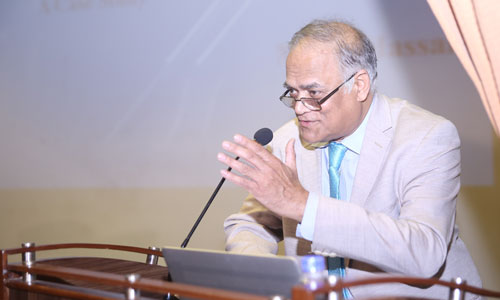
Dr. Tariq Rehman, Dean, Liberal Arts & Social Sciences, Beaconhouse National University, presented the Keynote Address. He spoke about the development of various scripts in the subcontinent such as Arabic, Sanskrit and Urdu. 'Writing also plays a key part in society – it marginalizes the world of oral tradition including the myths upon which it was contingent,' he specified. He concluded by stating that the South Asia is still witnessing a transition from oral to the written stage in the society. One consequence of the privileging of writing in this region is that the oral-based sections of our societies have been marginalized and subjected to neglect. Mr. Javed Jabbar then presented Mementos to Ms. Ava Cowasjee, Dr. Ishrat Husain and Dr. Rehman.
The panelists of the first plenary session were Neelam Hanf, Stephanie Lee, Mohsin Tejani and Neihan Yaqoob, and the moderator was Ms. Maria Hassan. Mr. Tejani, from the Ruqaiya Hassan Writing Centre (RHWC), stated that the RHWC is not affiliated with any institute, is non-commercial and is not monolingual. Ms. Yaqoob, from the Virginia Commonwealth University in Qatar talked about how most people think a writing centre is a corrective facility. This needs to be changed. The third speaker, Ms. Lee, from the Habib University, also said that a key challenge is to lead students to the Writing Centre and build a relationship with them. Ms. Hanif, from the FC College in Lahore, again faced the same problem about misconceptions amongst the faculty and students regarding the purpose of the Writing Centre.
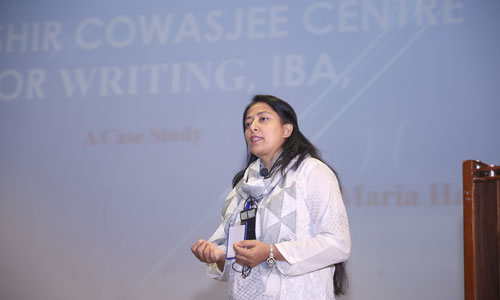
Following this, the Writing Centre Consultants gave short presentations regarding their experience at the ACCW. Wafa Fatima Isphani spoke about how being a writing consultant is more than just being a good writer; a large part of being a consultant is to gauge what the student is looking for. Muneeb Ahmed talked about what makes a good writing centre consultant – a consultant is essentially a facilitator rather an evaluator who should have the ability to brainstorm with students, be open to criticism, gauge students' level and deal accordingly. The third presenter, Daniyal Channa, mentioned how writing is not an act of isolation, but rather an act of introspection.
The panelists for the second plenary session on challenges of writing pedagogy in Pakistan were Dr. Sajida Zaki, Chairperson, Department of Humanities, NED University, Roger Smith, Director, EL Enhancement, Aga Khan University and Dr. Habib Ullah Pathan, Director, ELDC, Mehran University of Engineering & Technology and the moderator was Professor Nasreen Pasha from Kinnaird College. Dr. Zaki said that the greatest challenge is to teach writing in a culture which does not understand writing itself. Speaking about the importance of good teachers, Mr. Roger Smith said that a good teacher has immense power to help students in their writing. Dr. Habib Ullah Pathan spoke about the importance of creative writing, which is not just limited to the curriculum. To this Ms. Pasha elaborated that it is not just the job of the English teacher to improve a student's writing, but rather all teachers need to emphasize the importance of writing correctly. The floor was then opened for questions, after which Mr. Jabbar presented shields to the panelists of the first and second plenary sessions.
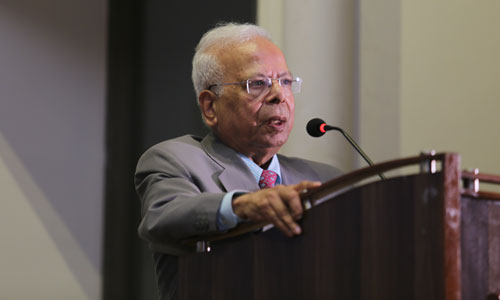
In the concluding session, Dr. Maria Isabel Maldonado Garcia from the Punjab University, spoke about the significance of organizing thoughts and putting them down into words. She summarized the two plenary sessions, and congratulated Ms. Maria Hassan and Mr. Javed Jabbar for their wonderful work. Mr. Jabbar then presented a memento to Dr. Maria Isabel.
The last speaker was Dr. Noman Ul Haq, Professor Social Sciences & Liberal Arts who gave the vote of thanks. Lamenting the loss of languages in Pakistan, he said, 'Our archives are collecting dust.' He thanked Ms. Maria, Dr. Ishrat and Mr. Jabbar. The First National Dialogue on Writing Centers was quite pertinent in the context of Pakistan's ESL (English as Second Language) status. It drew on global practices and was yet sensitive to local needs.