Poems on Partition
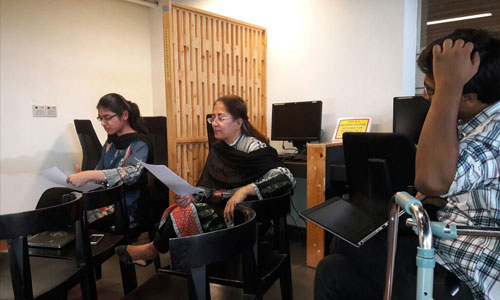
In continuation with literature as our theme ACCW, in its Second Study Circle, discussed the poetry written/sung during the 1947/71 partition in order to inch closer to a nuanced understanding of what is literature. The need for this is imperative because as Eagleton argues literature,
“refer[s] in the end not simply to private taste, but to the assumptions by which certain social groups exercise and maintain power over others.” (Eagleton 2008, 14)
Thus, it is worth unpacking, through examination of our lives, how our private tastes, may not be so private after all. A matter of personal opinion may not be simply a matter of personal opinion. That maybe, there are structural forces which need to be accounted for in how we view, construct, maintain, and dismiss certain categories and ways of living.
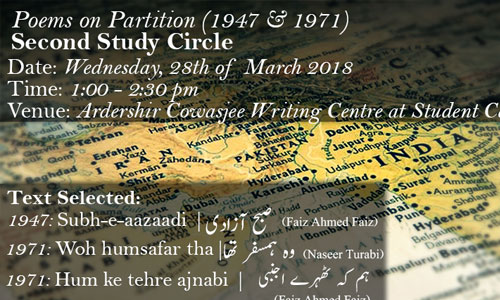
The 1947 pick was Subh-e-aazaadi | صبح آزادی written by Faiz Ahmed Faiz. And, the 1971 pick is ﻭﮦ ﮨﻤﺴﻔﺮ ﺗﮭﺎ ﻣﮕﺮ ﺍﺱ ﺳﮯ ﮨﻢ ﻧﻮﺍﺋﯽ ﻧﮧ ﺗﮭﯽ | Wo Hamsafar Tha, by Naseer Turabi and the other pick for 1971 is ہم کہ ٹھہرے اجنبی | Hum ke thehre ajnabi which is penned by Faiza Ahmed Faiz.
The study circle came about to be a highly interactive and thought provoking session. As previously mentioned some of the question which we addressed in our session were:
What the are assumptions that we carry? What other narratives, stories, are out there? Who do we include in our stories and who do we exclude? Who is valorized and who is not? Why is there such contention vis-a-vis the words “partition” versus “independence” when referring to the events of 1947?
To say the least, the art of poetry brought us closer to a nuanced understanding of what is literature and how we understand it to be! We had the honor of accommodating people from PH.D to undergrad level, who were deeply attached to not just poetry in general but the words of Faiz and Turabi.
The session started off with an unanimous understanding of how Urdu poetry is viewed as an art within Pakistan. Why it is so important, for poetry and poetic narratives to exist side by side with the mainstream voice. The nationalist voice which demands a certain story be told time and again, sometimes these stories are filled with bloodshed and hatred towards a common enemy! However, the idea to pick such diverse poetic narratives was to make our audience aware of how skewed and deliberately manipulated the stories we are told are.
For some, Naseer Turabi’s “wo humsafar tha” was just another romantic song for a Pakistani drama where Fawad and Mahira flaunted their relationship goals. However, Turabi’s classical piece “wo humsafar tha” was in fact an elegy for the violence committed against Dhaka, Bangladesh at large. Consider it as a tribute by him for Bangladesh as divided by borders but united by history. “ka dhoop chao ka alam tha. Judai na thi” unfortunately, we rather decorate this classic piece of writing with flowers and present to our nation as a love-struck song never talking about the true heartfelt thoughts behind it!
It was through Turabi’s poem that we could consciously address the unspoken, unrealized, guilt that West Pakistani’s elite carries towards their treatment of East Pakistanis.
Similarly, through Faiz’s wirting we saw how his feelings and thoughts had evolved from the 1947 partition to the 1971. For 1947 there was a glimmer of hope and longing in his poem; a perpetual hope to reach the promised (never)land; Pakistan. There was no justification for the bloodshed and mutilated bodies, however there was nothing to be done but bury the dead and pray for our forgiveness. However, with the ’71 incident we see that even this small hope is no longer there. A pessimistic tone has set in for there is a certainty within Faiz that another way was possible this time. An alternative to the bloodshed that ensued was possible. The possibility of creating of a left-handedworld existed and this possibility was forcefully annihilated.