What is Literature?
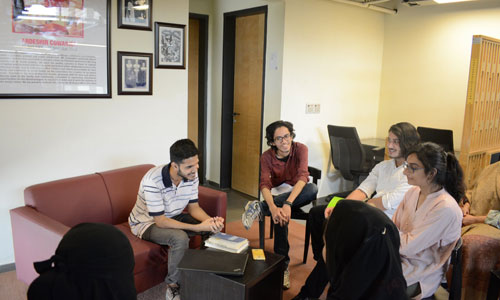
On 15th Feb 2018, the Ardeshir Cowasjee Center for Writing (ACCW) held its first Study Circle session on "What is Literature?" written by Terry Eagleton. The session was led by Muhammad Khurram, a senior consultant at ACCW.
In the past ACCW has arranged Book Club sessions, however, we felt that these sessions were restricted by their subject matter. The discussions of these sessions would revolve around a certain book. As such, we felt that the scope of our discussion was too narrow. Our vision too myopic. We were not creating a space that would allow the imagining of bodies and other ways of being. Our conversations were only for a privileged few who benefited from either their class, ethnicity, gender and/or an intersection of these and other variables. That is, these spaces of conversations were not accessible.
Moreover, simply having the time to read a book is an immense privilege. Someone of us does not have that. As such, these Book Club session would not be a place of learning, knowledge production, and dissemination. Therefore, we decided to revamp our discussion sessions into Study Circle sessions in order to be more accessible.
Additionally, we felt that it might be more fruitful to take a step back and ask ourselves the reasons for having these discussions in the first place. That is, why read literature, what is its significance, and what is "Literature" (with the capital L) after all? Before attempting to discuss "literature". We felt that it would be most instructive if we started first with the question of what is literature and how do we come to an understanding of it?
The session, as previously mentioned, was an open discussion. Reading the article in question to take part in the discussion was not needed. Some of those who came did read the article--which is quite short and funny--allowed for them to share their understanding of it. However, and we stress this, for those who had not read this article in question, their contribution definitely enriched our discussion. After all, what type of (critical) thinking is it if not does account for the lived experiences of our lives and others?
During the session there was a comfortable back and forth between each person as we tried to grapple with what is literature and why should we care. The age-old notion of objectivity, subjectivity, hard sciences vs. the soft sciences (are they even “science”?), epistemology, that is the theory of knowledge, the struggle between form and content, is the medium really the message? And, various other topics were touched upon.
In order to ground our discussion, since abstraction serves no purpose except to make obtuse, the examples of Friends (1994-2004) a TV show was brought up (TV shows have scripts, which are arguably literature). Does Twitter operate as a new form of serialization that produces literature? Did the canonization, and preservation, of Plato’s and Aristotle’s work come about because they are white men? Why do we continue to teach their work? Where are the women of colour? And, why do people insist that Shakespeare’s work has a profound understanding of “human nature” when he was, by all accounts, a cis-gendered, white, heterosexual person belonging to the lower class, and living in British during the 1500s?
In short, it was quite a delightful session. We look forward to having more of these Study Circle sessions throughout the semester under the theme of literature.